These gentlemen have a strong opinion about being martial artist versus being a cage fighter. I think they make a good point (albeit a little coarse) toward being a Superior Martial Artist.
What do you think?

These gentlemen have a strong opinion about being martial artist versus being a cage fighter. I think they make a good point (albeit a little coarse) toward being a Superior Martial Artist.
What do you think?

It all started on Fordham Road, but it didn’t end there.
Guardian Angels founder Curtis Sliwa walked the strip he first patrolled three decades ago as a teen, exchanging smiles and hugs with passersby as he led his crew on a patrol last week.
Sliwa, now 56, saw the area decay as a night manager at a McDonald’s in 1979.
“I used to keep the bathroom door locked,” he said. “Hookers would come in to turn tricks, dope fiends to shoot up. It wasn’t safe anywhere.”
Realizing the lack of police presence, he formed a group that launched Feb. 13 that year to protect the area and subways and make citizen’s arrests if needed.
They donned bright red jackets and red berets that became their trademarks, with metal handcuffs and police radios clipped to their belts. And Sliwa, outspoken and never at a loss for a sound bite, has been in the media spotlight ever since.
“I remember them from when I was a little girl walking around these streets – they always made me feel safe having them around,” said Pamela Deckard, 41, who grew up on Loring Place.
“They always make the Bronx proud; they really helped control the gangs that were running around here.”
Since their start, the Guardian Angels have expanded to 15 countries, with crews as far away as Japan and South Africa. Last month, members launched a patrol closer to home – Camden, N.J.
“Camden is now what the South Bronx was in the late ’70s,” Sliwa said. “It’s Dante’s inferno over there. Gangs, drugs and no police anywhere to be found.”
Layoffs recently slashed the size of the Camden police force from 400 to 200 officers. Sliwa’s Angels now have 40 members helping out in the area.
“Half the citizens of Camden are grateful,” Sliwa said. “The other half – the criminals – want us out. They slashed our tires last week and were ready to torch the car.”
The Guardian Angels were not always welcome in the Bronx, either. “McDonald’s fired me for being a vigilante,” Sliwa said. “[Then-Mayor] Ed Koch tried to bully me. Police unions thought we were jeopardizing their job security.”
Sliwa had admitted to faking some heroic subway rescues, including thwarting a mugging and rape. In 1980, he falsely claimed he was kidnapped by transit cops.
Last week, Sliwa – now a radio talk show host – walked past an NYPD Mobile Command Center near Bryan Park on E. Kingsbridge Road – a spot where thugs used to beat victims with bats and nunchakus.
Now, the problem is guns, said Angels member David Torres, 47.
“We have a great relationship now with the police,” Torres said. “Years ago, they just used to hate seeing our colors. We were trying to fight crime and we were the ones getting arrested. Now, we work together.”
Jamel Purnell, 6, a first-grader at Public School 83, walked alongside the Angels patrol with his mother and stopped to talk with Sliwa.
“I want to help people,” the little boy told the veteran crimefighter, with a grin across his little face.
“Fordham Road has improved tremendously since we started …. We’ve come a long way since running on the Mugger’s Express,” said Sliwa, referring to the No. 4 train that runs through the area. “There are still pockets of crime that are out there and that’s why we’re still here.”

BRIDGEWATER — It all started with a phone call from a parent.
Jennifer Rosander, the parent of a special-needs 4-year-old, was looking for a program to help her son with coordination and motor skills. Many specialists had suggested that she and her husband, David, do so.
She reached out to tae kwon do instructor Anthony Christian, who has run Anthony’s American Tae Kwon Do in the Martinsville section for 12 years and has been teaching martial arts for more than 20 years.
David Rosander said that when his wife approached Christian with the idea of starting a tae kwon do class for special-needs children, Christian’s response was that he had always wanted to do something like that.
“They worked together and what Jennifer did was try to identify people that she knew … people who might be interested in the program, so that’s how it all came about,” Rosander said.
There now are three children ranging in age from 4 to 5 in the special-needs class at the tae kwon do school in its first cycle, and Christian hopes that more children will enroll in the program.
“It was always a goal of mine. I wanted to contribute in a way to help make this world a better place through tae kwon do,” Christian said.
He also stated that he teaches not only martial arts techniques but also character development using his five tenants: courtesy, integrity, perseverance, self-control and indomitable spirit.
Christian said that from his program, the children learn balance, focus and how to follow directions. They do drills and strength exercises to help tone their muscles.
“They learn a little self-defense; they wear a uniform that has a tiger patched-paw on the right leg and right sleeve so they recognize their right side so eventually they understand left and right,” he said.
David Rosander agrees that his son has benefited from the program. He said as a result of the program his son’s focus, agility, balance and coordination have improved. He pointed out that before the program his son could not pedal a bicycle, and now he can.
Not only is the program therapeutic for his son, David Rosander added, but it’s something that his son enjoys and looks forward to.
“He likes putting on the clothing that they wear, and the belt,” he said.
The class begins at 12:30 p.m. Saturdays and lasts for 30 minutes.
Before the class, Christian works with young helpers ranging in age from 11 to 14. They volunteer their time to help the children with the routines. David Rosander said that there are usually about two to three helpers working with each child.
“They are very nice and warm to the children, making sure that they feel comfortable and at ease,” he said. “They just take them by the hand and start doing something simple to warm them up. It’s pretty touching.”
David Rosander added that his father-in-law was moved to tears one day as he watched the young helpers work with his grandson in the tae kwon do class.
Twin sisters Anjali and Pooja Patel, 12, are two of the volunteers. They learned about the special-needs program through Christian because they take classes with him.
Anjali said that she likes seeing how happy the kids get when she and the other volunteers help them.
“We teach them escape activities if someone attacks them. We try to do activities that help them improve their strength,” she said.
Pooja said the program is great “because the kids are really improving, and they feel more comfortable with their environment.”
David Rosander said he likes how caring and gentle the instructors and helpers are.
“I like that they so much want to help and how they take joy in working with the kids. … I like that it’s an activity my son enjoys and it helps him with coordination and it’s a skill that he has benefited from.”
For more information, visit www.anthonysamericantaekwondo.com.
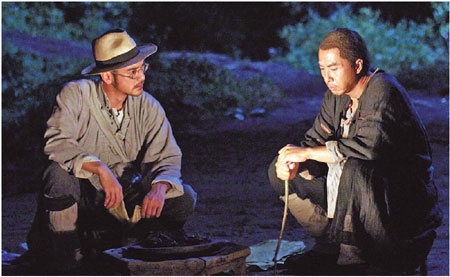 |
| Wu Xia, starring Takeshi Kaneshiro (left) and Donnie Yen, will be released on July 4, giving martial art films a new spin. Provided to China Daily |
Veteran Hong Kong director Peter Chan’s latest film aims to demystify martial arts, while also tackling moral dilemmas.
It requires courage to name a film after its genre, as audiences will expect it to be all encompassing.
But that does not seem to worry veteran Hong Kong director Peter Chan whose latest film is titled Wu Xia, or literally “martial arts chivalry”.
“Wu Xia will redefine martial arts,” he says.
Set in a small village in South China, the film has a storyline that has echoes of CSI or Discovery Channel’s Crime Scene.
A paper-maker kills two robbers and becomes the hero of his village. But a detective, a Chinese version of the fastidious doctor House of the eponymous TV medical drama, discovers from the bodies that only a kungfu master could have rendered the killing blows.
As his investigation unfolds, the paper-maker’s real identity is revealed and poses a catastrophe for the village.
The film is 49-year-old Chan’s first martial art film, although like other Chinese of his generation, he grew up on a steady diet of such films.
His first exposure to, and favorite of, this genre are the films of Jimmy Wang in the 1960s and 70s, known for his robust masculinity. However, as the genre evolved into gravity-defying fantasy after the mid-1990s, he felt estranged from it.
“I find many martial art films too illusory,” he says. “The only one that has thrilled me recently is Crouching Tiger, Hidden Dragon. Ang Lee achieves a breakthrough by making characters fly for a reason.”
He, too, wanted to give the old genre a new spin, but could not figure out how until 2009 when he saw a television program, which depicted in detail how a bullet penetrates a person’s skin, flesh, veins and heart.
“I had my concept – to explain Chinese martial arts through physiology and medicine. I then made a story to fit it.”
Thus, he sets the film in 1917, a time when Western science had a growing influence on the Chinese.
Like in House or CSI, the detective played by Takeshi Kaneshiro analyses the impact of kungfu attacks on one’s body.
While martial art films may show a master killing his enemy with what appears to be a light finger tap, Chan makes the detective tell the audience it is because the tap hits an important acupuncture point and causes a clot to form in a blood vessel. Frequent close-ups of organs and nerves enhance his explanation and create the film’s unique visual style.
“I consulted with acupuncture specialists, cardiologists and brain surgeons,” Chan says. “To shoot a film about swordsmen flying is a safe choice, but I don’t see a reason for me to do it. This is an established genre, which leaves little room for originality, but at the same time I see a chance to revitalize it.”
Not everything is new, though. Action remains a critical part of the film, to be released on July 4.
Chan ropes in Donnie Yen, the star of Iron Monkey and the Ip Man series, to choreograph the fight scenes and play the mysterious paper-maker. With his mastery in both Chinese kungfu and Western mixed martial arts, 48-year-old Yen has built his name as the new kungfu superstar after Jackie Chan and Jet Li.
Both Yen and Chan dislike wires, and agreed that the fighting would be dazzling but more grounded.
Characters do not suddenly fly off the ground or race on water, but there is dramatic close-contact combat on the ground and even one scene on a rooftop.
The Hollywood Reporter calls the action sequences “swift and savage”, and “arguably the best that lead actor Donnie Yen has choreographed for years”.
The film’s ending has Chan and Yen paying their homage to traditional martial art cinema and the signature figure of its golden days. The 68-year-old Jimmy Wang, China’s John Wayne and star of Chang Cheh’s One Armed Swordsman series, has a fierce fight with Yen, which ends in a dramatic twist.
Chan presents his own world of swordsmen, where the hero’s moral struggles and self-discovery are as painful as those of the common people. The detective has to decide between sticking to the law or giving the criminal a chance, while the paper-maker is haunted by his complex past.
Variety’s Justin Chang said he was reminded of David Cronenberg’s A History of Violence when watching the film in Cannes in May, noting that “this clever if over-amped thriller tackles themes of identity, honor and the latent killer instinct with a playful spirit that’s never at odds with its underlying seriousness”.
Chan describes the film as another exploration of answers to life’s problems.
“Westerners go to shrinks when they have confusions about life and themselves, but in China we don’t usually do that. We find our own ways,” he says. “For example, I make films. I spend two years shooting a film to find answers.”
In the war epic The Warlords, he questions if one should be forgiven for sacrificing brothers if that creates welfare for a larger group. In the acclaimed romantic tale Comrades, Almost a Love Story, he seeks the answer to what is true love.
“In Wu Xia, I want to know, can we really wipe out our past?”
And the answer, he says, is up to the audience.
Powered by WordPress & Theme by Anders Norén