
"There are no superior martial arts, only superior martial artists"

Author: TSMA Page 200 of 202

Still Kicking: Martial Arts for the 40+ Crowd

20110614-martialartsold-450.jpg

Charles Bolton’s face was bright red as he muscled through his umpteenth push-up. It’s one of 1,000 the 71-year-old pumps out during each of his thrice-weekly, four-hour workouts at Kensington, Md.’s Black Belt Martial Arts Center (10576 Metropolitan Ave.; 301-946-5425, Bbmac.com).

But if you think the fifth-degree tae kwon do black belt must have been a child prodigy like Jackie Chan, you’re wrong. The retired CIA employee didn’t get started until he was 44, which as many other middle-aged martial artists can attest, is definitely not too late.

A lot of changes happen in one’s 40s, explains tae kwon do master Sang H. Kim, 52, author of “Martial Arts After 40.” “Martial arts training can be one such positive change,” he says. “The slower rate of metabolism that begins to occur in our 40s can be reversed, countering weight gain. [And] mood swings caused by hormonal changes can be improved by active participation in training.”


Active participation, however, can also hurt. “I can’t tell you how many times I attempted a kick and ended up on my rear end,” Bolton says.

So Kim emphasizes the importance of discussing your program with your doctor, and then progressing slowly but steadily toward your goal. “Accept limits; explore possibilities. Discover the uniqueness in your mind and body at this age,” says Kim, who admits he’s scaled back his training considerably over the years. “I don’t do what I did when I was 18 — the crazy flipping over 20-foot-high cliffs up in the mountains and landing on the ground.”

Brazilian jiujitsu instructor Roy Harris, who released the DVD “Brazilian Jiu-Jitsu Over 40,” says the style you choose to pursue doesn’t matter nearly as much as the instructor. The right one should be able to modify the moves to fit your abilities. “You can learn as much and have as much fun as anybody else in class,” he adds.

Bolton was drawn to tae kwon do for its promise of a full-body workout. He soon learned that studying the huge number of “forms,” or choreographed movement patterns, bolstered his brain as much as his muscles. “Concentration and focus in tae kwon do is everything,” he says.

But he was also so attracted to Muay Thai that he decided to add it to his repertoire. (He earned that black belt at age 66.) The efficient and high-energy style was the right fit for 51-year-old Monte Mallin, who began training at BBMAC last year after his son, who was taking classes there, urged him to do more than watch. “Now I can’t live without it,” Mallin says. “I plan my life around it.”

It’s the same for 48-year-old Beth Canha. When the former marathoner discovered BBMAC’s Muay Thai program at age 45, she couldn’t do a push-up at all. “And I really couldn’t do a full sit-up,” she says. After regularly attending two or three classes a week for three years, however, Canha eventually knocked out the 75 push-ups and 100 sit-ups required to earn her black belt. “I like how I feel now — so much energy,” she says.

Maybe even enough to do 1,000 push-ups one day.

Magic in Movements
One of the most popular martial arts for older adults is tai chi, a slow-moving, breath-focused practice developed in China that research indicates can have a positive effect on one’s health. In a recent University of Missouri study, patients undergoing chemotherapy improved their cognitive abilities by attending tai chi classes.

Photos by Teddy Wolff
 

Secret to Life

From the movie City Slickers
[jwplayer mediaid=”159″]

For a great article on Curly’s Law by Seamus Anthony

http://www.rebelzen.com/2008/08/curlys-law-how-a-fictitious-hollywood-cowboy-showed-me-the-meaning-of-life/


Is this what MMA is really about?

A clip from the movie Red Belt, which makes one wonder if what Marty Brown says is true..

[jwplayer mediaid=”54″]

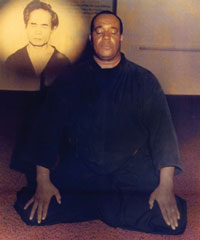
Dr. Moses Powell

The Teachings of Dr. Moses Powell

“The Last Interview”

By  Jerry Denson

It is said, “Nothing is more honorable than knowledge.”  “While kings rule over the people, the learned rule over the kings.  Knowledge distinguishes men from the lower animals, and it is only for knowledge that men are honored.  Honor is not due to a man because of his physical strength, because a camel is physically stronger than a man.  A man is not honored for his large body, as the body of an elephant is bigger than that of a man.  The ultimate value of everyman lies in his knowledge.”  Without a doubt, Dr. Moses Powell was one of the greatest luminaries in the field of martial arts.  Many will remember him for his astounding one finger roll, but I will forever remember him because of his innovative and practical approach to teaching.

Prior to the day of his passing, it was a privilege for e to have the opportunity to speak with my instructor via phone calls, and personal visits.  Deep down I felt that Dr. Powell’s time with us was coming to an end.  We conversed about many things; from martial arts to the enigma of life and death.  One of the things he talked about most was the “love of family”.  Dr. Powell believed that family held the most important priority in life, next to one’s personal health.

Many a time he approached me with the thought of my writing on his personal life, but unfortunately it never materialized.  I once inquired from Dr. Powell what he thought about death, and this is what he replied,” death is separation of the soul from the physical body.  I do not fear death, and when you look at it from the proper frame of mind, death is a blessing, especially when it takes away the pain and agony of suffering.” Dr. Powell reminded me that at death is upon all of us, the young, the old, rich or poor, good or evil.  His last remark on the subject was,” everyone should hope that their good deeds outweigh their bad deeds, because in the end that will be all that matters.”

Regarding the Martial Arts styles and discipline, I asked Dr. Powell what style or discipline he considered more related to combat worthiness.  This was his response: “there is really no such thing as the best style or discipline when it comes to self-defense, all disciplines have something valuable to offer and have their flaws. A student who practices karate will only help to enhance his capabilities if he or she is enrolled in a boxing class, Kung Fu class, Jujitsu or other discipline.

Each Martial Arts system should be considered a support system for all disciplines.  If a judo practitioner approaches you, and applies the principle of Kuzushi, or breaking the balance, you will undoubtedly be in trouble.  If you are faced with someone who’s really skilled at using his legs and you are not skilled at closing the gap between you and that person, its going to be “a rough day.”

When I asked Dr. Powell about grappling, he commented,” grappling is very effective, but is only practical when you are fighting one person.  Even when you are applying sacrifice throws this is only practical when you do not have to be concerned about a group of people attacking you.  The best fighter is the one who has kicking skills, grappling skills, boxing skills, and the most important skill, the ability to remain calm in the midst of battle.”


Dr. Powell expounded on the realities of Dojo training and actually defending one’s self in a truly hostile environment.  “There are many Dojo warriors, but very few street warriors.  It takes heart to defend yourself, especially when the odds seem to be against you.”  Being s superstar in the Dojo means nothing unless you can apply those same quality skills in an uncontrolled, dangerous situation.  Being good at performing Katas or forms and not being good at fighting is an obvious unbalance.  It is my own opinion that man’s greatest enemy is his own self-delusion.  Wearing a belt around your waist, regardless of its color does not guarantee proficiency.  It is hard work and humility of mind that molds the true warrior; not laziness and arrogance.’

In closing, I’d like to say this—Dr. Powell was truly a great teacher.  He taught me that knowledge cannot be acquired except through modesty and humility.  He also taught me that one branch of knowledge is a guide to another and that true knowledge purifies the mind of evil.  Yes, I can still hear his words, “The Martial Arts are twenty-five percent physical and seventy-five percent spiritual.”

Dr. Powell, we salute you and hold you deep in our hearts forever.  From your students in Miami, Florida to others around the world, we bid you God’s peace and love.

Dr. Moses Powell born January 13, 1941, in Norfolk, Virginia, was one of the World’s Foremost Martial Arts Experts in Jujitsu and an Instructor to several Action Celebrities, most notably, Wesley Snipes; the Star of THE ART OF WAR as well as the BLADE Movies; died Saturday, January 22, 2005 at home from respiratory failure . Dr. Powell is survived by his beloved life mate Gina Barnett Powell, who for the last 12 years was the pillar of strength for him and his Sanuces Ryu Jujitsu System. Moses Powell was considered a living legend and shared the spotlight with Chuck Norris, in the movie, “The Warrior Within, A Tribute To Bruce Lee” and was honored in the TV show titled “Masters of the Martial Arts”.

Dr. Moses Powell, was a Member of the Black Belt Hall of Fame. Dr. Powell was one of the first African American Martial Artist to Instruct Law Enforcement (DEA), Secret Service and the FBI, and was invited to demonstrate his survival techniques at the United Nations. According to K. Leigh Witsotzkey of ModeWeekly, “Sanuces Ryu Jujitsu, a Fighting Art System developed by Dr. Powell, is a unique Martial Art System that readies students for combat, rather than simply teaching form”.

Although we will not have the opportunity to see Grand Master Dr. Moses Powell in action again, and witness the fluidity and effectiveness of this Art by one of it’s Masters, he will always be in our memories and those closet to him will miss him dearly.


Page 200 of 202

Powered by WordPress & Theme by Anders Norén